A handbook of Sanatana Dharma · nineteen evenings by a lamp
You were probably handed this tradition without ever being told why any of it is true. This book expects you to refuse to take its word for anything. Every teaching with its source. Every claim labelled — teaching, practice, or resonance. Honest notes where the evidence stops.
Why this lamp is lit
This site has one intent: that a young person who scrolls past a hundred louder things finds, here, a reason to be interested in their own dharma — and discovers that it can carry real weight in a real week.
Interest first. Nothing here begins with "you must believe." It begins with games you can lose, debates you can join, questions you can ask out loud, and a book that shows you where every one of its claims is written — and says plainly where the evidence stops.
Strength for the everyday. Exam nights, tryouts, pressure, comparison, failure. The Bhagavad Gita was spoken to a young person having the worst morning of his life, and its first medicine — do the work, release the result — is still the sharpest performance psychology ever written. It is in your house already. This site teaches you to use it.
Roots that hold. You come from people who kept this lamp lit through centuries that tried very hard to put it out. Knowing that story is not nostalgia — it is a platform. A generation that knows its story cannot be erased; a generation that doesn't becomes someone else's audience.
Start anywhere: read, play, or argue. All three doors open on the same road.
Don't just read it — play it
Every game plays the way the book argues: you commit first, then you see what the book says. Single-player by design — no accounts, no leaderboards, nothing you do here is visible to anyone but you.
Dispel maya-forms with viveka, answer the rishis, breathe the flame back, reach the gate.
Your six inner enemies, wearing the demon shapes the old stories gave them.
Four honest sentences carrying one that claims too much. Find it.
Flick each statement to its bench, then restore the scrambled orders.
"Tat tvam asi" is waiting for its meaning. Every match cites its source.
The book's page-one promise, turned around: you do the labelling.
Seventeen of the sharpest objections. Work out your answer first.
How it argues
A fifteen-year-old comes home stung by questions she couldn't answer. Her grandfather doesn't lecture her. He sets three rules, and the whole book is held to them.
Everything I teach you, I will show you where it is written.
We will always say plainly whether a thing is a teaching, a practice, or a resonance.
We will never pretend a poem is a proof — because the poems are magnificent enough without pretending.
Two recurring boxes
One hands the microphone to the sharpest objection. The other marks exactly where the evidence stops — including when that means contradicting the book's own enthusiasts.
The challenge: an oral tradition is a telephone game, so the texts must be mush by now. The reply: the telephone game has one rule — whisper once, no checking. The Vedic schools ran the opposite rules, and manuscripts from opposite ends of the subcontinent agree to an accuracy that stuns textual scholars.
How should a scientific mind hold chakras, prana, and kundalini? As the yoga shastra's working model of inner experience — a map refined over centuries by practitioners. It is not an anatomy chart; no scan shows a chakra. Use the map for practice, report honestly what you find, and claim nothing you have not verified.
Eighteen times
No scan shows a chakra. Two ideas can rhyme without one proving the other. Sound changes which genes speak, not what they say. The honest notes are counted, not hidden — you can read all eighteen before you read anything else.
Nineteen chapters
…and eleven more, plus an answer key, a question bank, and a glossary. See the full contents, or read them as plain pages.
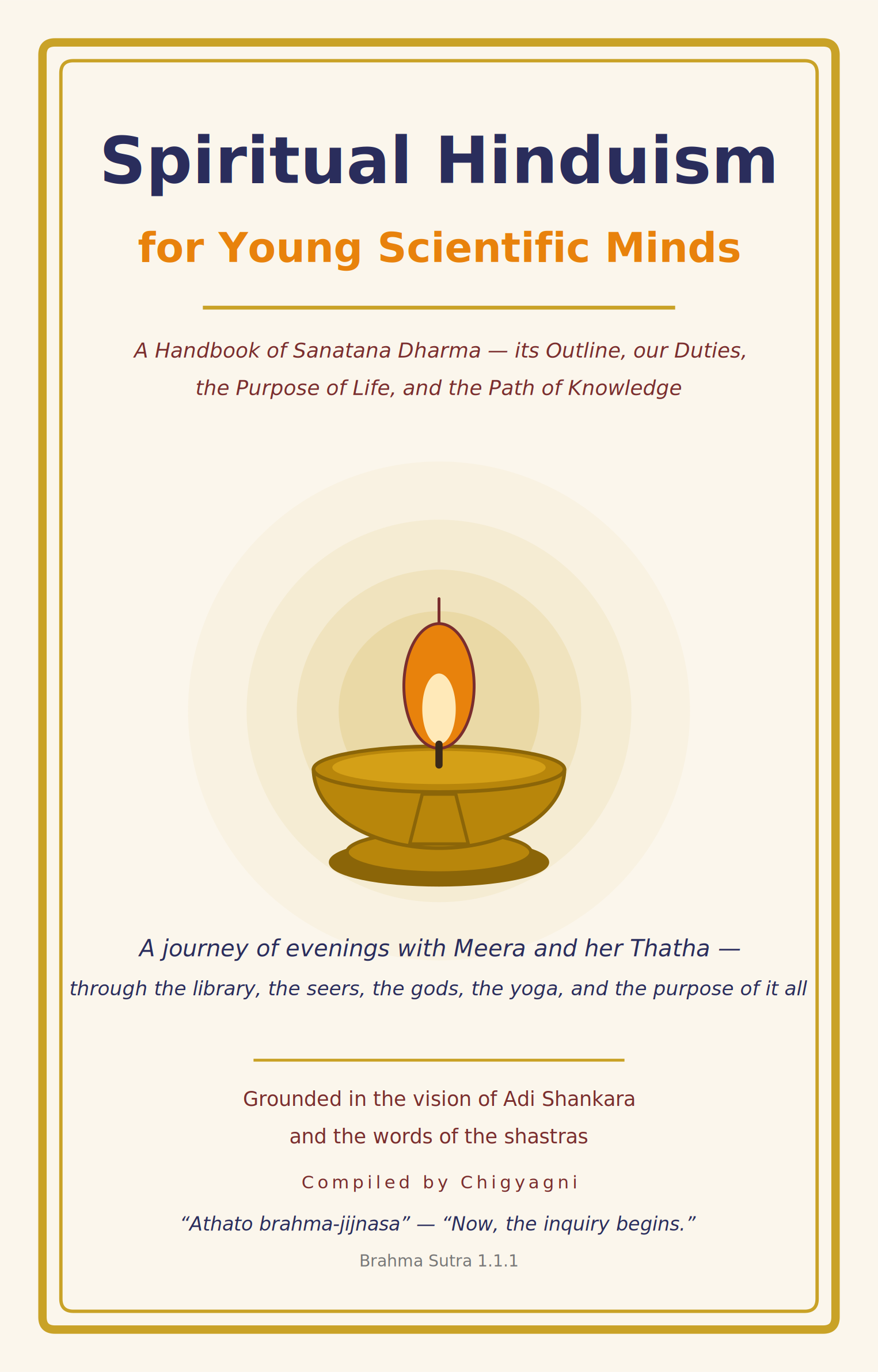
The book
Roughly four hours of reading. Nineteen chapters, thirty-four figures, seventeen debates, eighteen honest notes, and a question with an answer key for every chapter. Free to read online, and free to keep.
If an adult is reading over your shoulder
Read it your way
One more door
Fair. Nobody here will chase you with a pamphlet. But there are four minutes of the honest argument waiting — your origin story, the people who refused to forget, and a platform built of questions.
See this before you walk away